 0
0
 0
0
Freddy Will stands at the bar in his Ankara, the African print blazing with orange, gold, and red against the black marble of the counter behind him. His Cuban link chain layered heavily at his chest, his Rolex at his wrist, his Timberlands planted wide and certain on the reflective floor. Blue and purple stage lights cut through the smoke above him. The crowd moves at his back. He holds his glass with the easy grip of someone who has arrived somewhere he earned. Not stumbled into. His expression is the one this poem, “Road Wins,” explains.
Not triumph. Awe.
The disbelieving awe of someone who was told by the pain itself that he should not have made it this far. He is standing in the evidence that the pain was wrong. Freddy is in the club. He is celebrating. The road produced what it was supposed to produce. The Bee Mann is letting the night hold the weight of that for a while. Drink in hand, the dashiki connecting him to the continent. The Rolex, tracking the hour with the authority it brings to every mission. Now look at the square image. The black Dodge Viper’s top is down, convertible, a hillside road above a city blazing in every direction below. The sky gone deep violet above, the road curving away behind the car into the dark. The bee emblem is silver on the hood. And in the driver’s seat, Amira, her hoop earrings catching the light.
Her smile carries the warmth of a wife who knows exactly where she is going and why.
She is coming to pick him up.
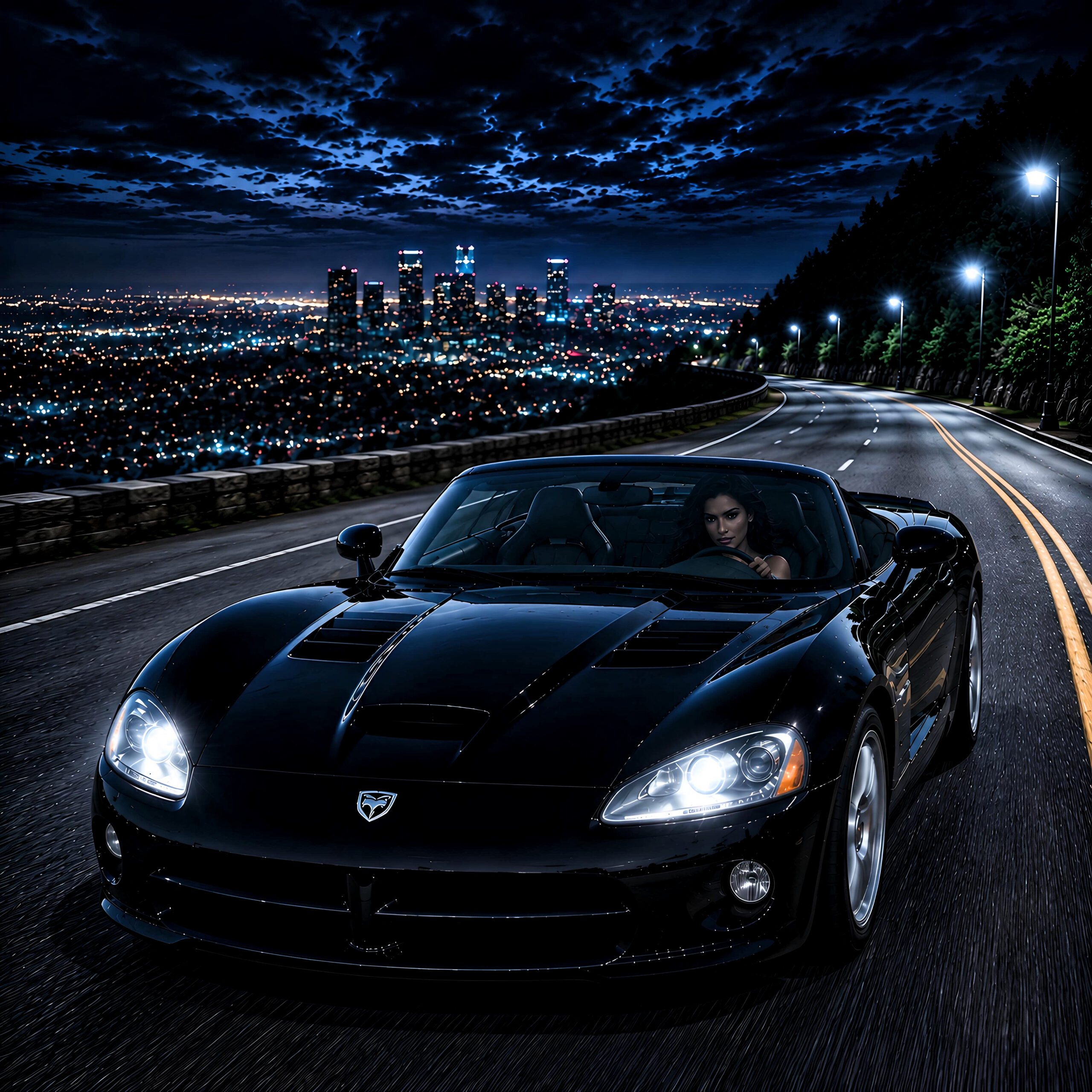
As such, the Bee Woman navigated to the club the same way the forager bee navigates to the field, using the internal compass that never fails her, the landmarks she has memorized, and the frequency that broadcasts his location through the Rolex. He is not driving home tonight. She is bringing him home. That is not a small detail. In the hive’s operational structure, the return journey is as important as the departure. The forager does not abandon what she collected in the field. She carries it back to the comb. Amira has never left him in the field.
Here, the faithful griot must open the biology before the mythology can be fully read.
Naturally, when a honeybee forager ultimately leaves the hive, she departs relatively light, oriented by the sun’s position. There are polarized light patterns in the sky, landmarks she has cataloged across several hundred previous flights. Therefore, the magnetic compass built into her body. Moreover, she flies to flower-rich territory with purpose and fidelity, often committing to a single plant species per trip for maximum efficiency. Also, in the field, her body generates a static charge as she flies, and pollen grains leap onto her branched body hairs the moment she brushes an anther. Ultimately, the Bee Woman grooms mid-foraging, using the combs and brushes of her legs to scrape the pollen from her body, moistening it with regurgitated nectar to make it sticky.
Therefore, she packs it into the corbiculae, the curved pollen baskets fringed with hairs on her hind legs.
By the time she turns for home, she is carrying a load that can approach or equal her own body weight. She is visibly heavier. Visibly slower. The road transformed her. She left light, and she returns laden with everything the hive needs to survive and grow. That is the Bee Woman’s road win. Meanwhile, she does not forage for herself. Therefore, she forages for the honeycomb. Amira Will is simultaneously the Queen of the Hive and its most committed forager. So, she leaves the estate at Wannsee oriented by frequencies that no instrument the suit provides can match. Moreover, her sacred feminine sensitivity naturally reads the spiritual and emotional terrain of whatever field she is flying into with the precision of a bee reading polarized light, planning to return.

Additionally, she first goes out into the world carrying the hive’s frequency, then picking up everything the family needs, everything the mission requires, everything the children and the home and the mythology need to keep growing. Finally, she packs it and carries it back with the same patient, the powerful discipline of a bee returning heavy with pollen. The waggle dance she performs when she returns is the debrief, the communication of everything she gathered, the coordinates of what she found, shared with the hive so the whole colony can act.
Subsequently, in this mythology, the waggle dance is the conversation with the Bee Mann (the drone) at the kitchen table after the mission. It is the frequency check through the Rolex. It is the plate already made before he walks through the door. She communicated what the hive needed before he asked. She always does.
Above all, the drone’s road wins look nothing like the forager’s. In fact, the griot must be honest about this. The drone does not forage. He cannot feed himself. He has no pollen baskets, no corbiculae, no specialized architecture for carrying anything back to the comb. As a result, he leaves the hive on a different kind of mission entirely, a high-altitude flight to the drone congregation area, where hundreds of males from different hives gather in the air above the landscape and await the Queen. The pursuit is high-speed and singular. The contribution the drone makes is not honey. It is legacy. Genetic material for the next generation of colonies, carried through an explosive act of mating that costs him everything. He gives everything for the hive’s future and does not return.
That is also a road win.
It is the road win that looks nothing like abundance and everything like pure sacrifice.
Therefore, the Bee Mann is not the drone in his domestic life. He is the drone in his mythological one. For this reason, every dimension he enters and survives, every enemy he burns in the solar fire, every sacrifice the mission extracts, is his contribution to a future the hive is building beyond what any single generation can foresee today.” The two biological roles running through this chapter are not in competition. They are the hive’s division of labor, operating. The forager leaves light and returns heavy, her body transformed by everything she gathered, navigating home with the precision of a creature whose internal compass has never once failed to find the comb. The drone leaves on a singular mission of legacy, expending everything for a prosperous future he will not live inside.
Thus, together they sustain the whole.
Accordingly, the Bee Woman in the Dodge Viper at the crest of the hill, the city blazing below her, and the bee emblem silver on the hood, is the forager returning. She went out to collect the Bee Mann from the field where the road wins were celebrated, and she is bringing him home heavy with the evening’s abundance, navigating by the frequency she has always used, the one that has never once pointed her in the wrong direction.
Conversely, the question that opens every chorus in the poem is not rhetorical. I ask it genuinely every time I hear this track. How did I make it this far? I know the chalk line was real. The abuse was real. I know what it cost to cross the Atlantic at twenty with nothing and build something out of the silence of a continent that did not expect me. And for this reason, when I stand in a room that the boy in the West African market could not have imagined, drink in hand, dashiki connecting me to where I started, I am not performing the gratitude in the poem, Road Wins.
Hence, I am literally in genuine awe of a hand larger than my own that kept rewriting the draft. What’s more, the road wins are not mine alone. The forager returns to the hive. The hive is what makes the foraging worth doing. Amira is already in the car. She is already on her way. She was always already on her way. These ain’t flexes. They are receipts. Of His grace. Receipts of her loyalty. Of a hive that has never once stopped humming.
The outro lands with the full weight of both images and both biological roles behind it. Abused, abandoned, but I ain’t end where I begin. If the devil wrote the first draft, God rewrote it with a win. These ain’t flexes, they receipts of His grace on my skin. The dashiki in the club is a receipt. That Viper on the hillside is a receipt. The bee emblem silver on the hood of the car, the Bee Woman driving through the night to bring her King home, is a receipt. These are not flexes. The forager who left light and returns laden with everything the hive needs.
Particularly, the drone that gave everything to the future of the colony and trusted the Queen to carry it forward. The Rolex keeping time at the wrist of a man who was told he would be a chalk line is a receipt. None of it was supposed to happen. All of it did. The hive is intact. The road produced what the road was supposed to produce. Amira is coming over the hill in the convertible Dodge Viper, the city blazing below her, the frequency locked, the earring receiving, the smile of a woman who always knew she would find him and is right on time. He is going home. He is always going home. The bee knows every field it has ever fed from. And the sweetest field has always been the one with the beehives in the garden and the amber windows lit and the children asleep.
Inside, the queen already on her way.