0
0
 0
0
The Introduction
To embody the essence of a traditional Christian or a Judeo-Christian identity is to recognize oneself as an Israelite. This designation signifies a sacred covenant, an allegiance to the divine entity known as Jehovah or Yahweh. Within this Christian premise, entry into this familial bond is achieved through two distinct pathways. The first route is through biological heritage, while the secondary path is through spiritual transformation, embraced by faith in Yeshua, the Christ. This figure is universally recognized as Jesus Christ. Yeshua’s death and sacrifice on the cross resulted in two key outcomes. We will categorize these outcomes as follows.
First, his physical body served as the ultimate sacrifice atoning for sins. It dates back to the disobedience of Adam and Eve in the Garden of Eden, which caused humans to lose their place in the divine plan. Second, His blood became the means of redemption for all who follow his teachings. This allegiance spans two realms: the spiritual, known as the Kingdom of Heaven, and the physical, which includes the earth and the Kingdom of Israel. Let’s clarify the importance of two key terms. An Israelite is a dedicated follower of Yahweh, tracing his or her lineage from Noah—who fathered the Semitic peoples—and back to Abraham, the first patriarch.
The popular term “Jew” refers to those descended from Judah and Benjamin. Judah, Israel’s fourth son, held a leadership role, while Benjamin, the youngest, formed a community that aligned with Judah. They eventually became part of its broader Jewish community. Both Benjamin and Judah are Israelites, collectively known as “Jews.” The full term is “Judah.”“Jew” is its shortened form. Jews are two of the thirteen tribes of Israel. For an exhaustive chronicle of this ancestral chain, I suggest reading “Brazenitout: Volume Two.” To summarize: following King David’s establishment of the Kingdom of Israel, his son Solomon erected the first temple.

The Israelite lineage originates from a son of Jacob, whose name was divinely altered to Israel. Jacob adopted both of Joseph’s sons, Ephrim and Manasseh. This patriarch, Israel, was the offspring of Isaac, and he, in turn, descended from Abraham. At a troubling point in history, tribal conflicts led to a split, resulting in secession. Ten tribes (eleven in total if you split the Tribe of Joseph into two) continued with the Kingdom of Israel, while the other two (Judah and Benjamin) merged to establish the Kingdom of Judah. Those remaining with the Kingdom of Israel continued identifying as Israelites, whereas the people of Judah became known as Jews.
Judeo or traditional Christians believe the tribes of Israel will be reunited, forming a revived Kingdom of Israel with Yashua reigning as king for a thousand years. This will happen after a series of wars. The Kingdom of Israel was defeated in war, leading to its downfall. Its people became known as the Lost Tribes of Israel. While many merged into neighboring regions, some dispersed worldwide, settling in Africa, Asia, Russia, and the Americas. Later, the Kingdom of Judah also fell to military conquest, but its people survived, maintaining their Jewish identity. Their history thereafter was a fascinating blend of hardship and periods of resurgence.
The War Report
Many Judeo-Christians believe that when Yeshua died, He went to Hell. There, He defeated Satan, conquered death, and the grave. Everyone went to Hell before. Upon His resurrection, we received a pass to Heaven. It’s from confidence in His victory that we are instructed to put on the whole armor of God and stand firm, ready for both spiritual and physical battle. In the scripture, Paul wrote. Ephesians 6:10–18 “Finally, be strong in the Lord and in His mighty power. Put on the full armor of God, so that you can take your stand against the devil’s schemes. For our struggle is not against flesh and blood, but against the rulers, against the authorities, against the powers of this dark world and against the spiritual forces of evil in the heavenly realms.

Therefore, put on the full armor of God, so that when the day of evil comes, you may be able to stand your ground, and after you have done everything, to stand. Stand firm then, with the belt of truth buckled around your waist, with the breastplate of righteousness in place, and with your feet fitted with the readiness that comes from the gospel of peace. In addition to all this, take up the shield of faith, with which you can extinguish all the flaming arrows of the evil one. Take the helmet of salvation and the sword of the Spirit, which is the word of God. And pray in the Spirit on all occasions with all kinds of prayers and requests. With this in mind, be alert and always keep on praying for all the Lord’s people.” Remember, this is the introduction. I’m summarizing.
Those familiar with sacred texts will probably recognize the Apostle Paul. His letter to Ephesus, a group with Jewish origins, is now known as the Letter to the Ephesians. This text offers advice, including instructions for children to obey and honor their parents in the Lord, for parents to nurture and care for their children, for wives to show respectful regard to their husbands, and for husbands to esteem their wives. As the text progresses, Paul discusses the need to prepare ourselves for spiritual battles by putting on the armor of God. Many Judeo-Christians believe that the fight for Israel promotes the coming of the Kingdom of Heaven.
This idea fuels hopes to see that day, when the Holy Land would once again be favored by divine grace. However, the might of Roman conquest reminds us that when the Kingdom of Judah broke apart, its people dispersed like chaff. The land was entrusted to new inhabitants, now known as Palestinians. The Romans renamed the land of Israel itself, from Israel to Palestine. The Palestinian presence would endure for millennia, establishing a new mark on the land that predates Joshua’s victory—with the histories of countless generations who have called this place home. Many of you are already aware of this fateful information.

Today, a grand and historic mosque called Al Aqsa stands on the very stones that once supported King Solomon’s Temple. It represents another Abrahamic faith that rose from the destruction of Israel before the Islamic Empire. This layering of holy sites and overlapping histories and beliefs has inevitably fueled further discord. The ancient prophecies of the Israelites, once a source of reassurance, now carry a more threatening tone, echoing old words of impending wars to reclaim the land. For Judeo-Christians, every dispute over this sacred ground is not just an earthly conflict but a spiritual battle, foreshadowing the final judgment.
The Judeo-Christian community watches with hearts that are both hopeful and burdened. We observe history repeating itself, ancient grievances resurfacing. The Holy Land continues to be a bloody battlefield. Despite this chaos, we find reassurance in the scripture. Suppose the world were truly on the verge of divine intervention. In that case, these wars should be inevitable: the rumble of armies, fervent prayers, and persistent claims over the Holy Land—all parts of a larger, ominous destiny, hinting at the imminent arrival of the Kingdom of Israel. That would include the discovery of the Eleven Lost Tribes and the reconfiguration of Israel to a monarchy.
The question is: what happens if Israel is defeated? We have seen such scenarios before, leading to the total destruction of God’s people. Israel’s existence today is prophetic, given the efforts of powerful empires to wipe it out. Without Israel, Judeo-Christianity would also disappear, making this a matter of survival. For traditional Christians, the revival of the Israelite kingdom and rebuilding Solomon’s Temple are the fulfillment of divine prophecy. Such events would be a disaster for those opposing Israel, whose goals conflict with ours. That would fuel even more conflict. In this struggle, brutal acts on both sides are inevitable, no matter who wins.

For Judeo-Christians, Yahweh’s stance is unmistakably clear. He caused the great flood with Noah, renamed and relocated Abraham, and destroyed the enemy’s cities with fire and brimstone. While Isaac experienced calmer times, Jacob became the father of the nation. In 1 Samuel 15, Yahweh commands Saul through Samuel to destroy the Amalekites, who had opposed Israel during their wilderness journey. This command included destroying both the Amalekite people and their livestock. A recurring theme for followers of Yahweh is to crush the enemy. In 2 Corinthians 6:14, Paul advises early believers: “Do not be yoked together with unbelievers. For what do righteousness and wickedness have in common? Or what fellowship can light have with darkness?”
For adherents of Judeo-Christian tradition, the reality of warfare (physical or spiritual) is an enduring constant, destined to persist until the ultimate fulfillment of divine prophecy. This enduring struggle finds its symbolic representation in the opposing concepts of Babylon and Zion. No devout follower of traditional Christianity harbors a desire to dwell within “Babylon.” We lament the rivers of Babylon. Instead, our fervent aspiration is to reside in “Zion.” The path to this sanctuary, we understand, necessitates triumph in both the spiritual and physical conflicts that define the narrative of Israel and the celestial realm. This is the double standard.
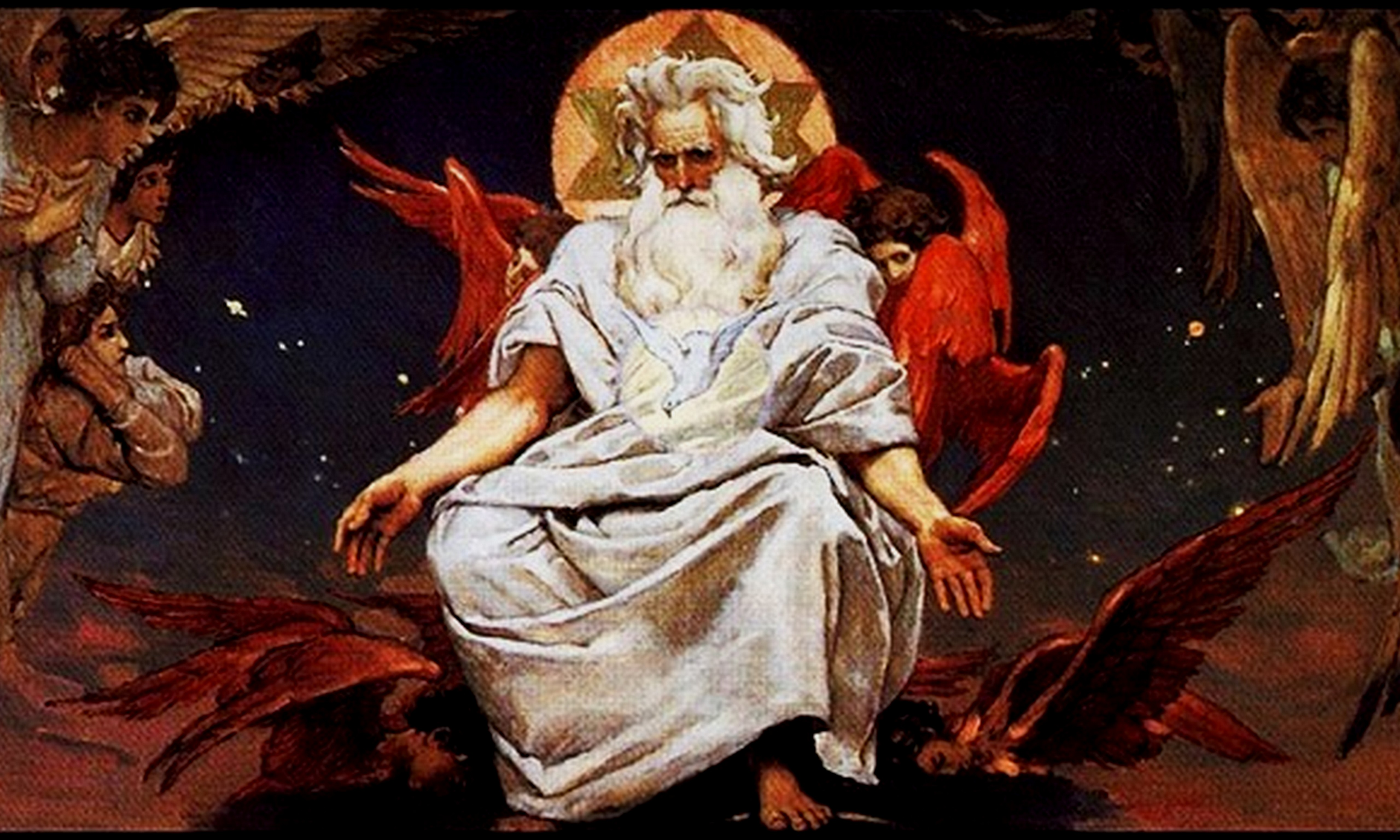
Indeed, the genesis of the celestial battles predates humanity’s existence, originating in the very moment of Yahweh’s decree of creation, “let there be light,” which cast a reflection on Himself, creating His shadow. That shadow came to life as His counterforce, Azathoth, also known as the Shadow of God. This counterforce opposed God’s creation and launched the “Terrible War.” Azathoth is the true embodiment of darkness, even before the advent of humankind. Yahweh and His celestial legions were compelled to confront and subdue this adversary. The ultimately banished Him, His forces, and their creations to a parallel dimension of darkness, the very abyss where wickedness holds sway. My point? Our loving God is a god of peace and war.
A second celestial schism erupted as Lucifer marshaled a third of Heaven. The annals of Judeo-Christian belief are replete with accounts of formidable archangels like Michael and Gabriel, who valiantly confronted Lucifer’s uprising. Following Yahweh’s triumph over the insurgent celestial beings, another pantheon of adversaries to divine authority emerged – the now notorious demons, recognized by many. This spiritual conflict then spilled into the terrestrial realm, specifically the Garden of Eden, where humanity, God’s most recent masterpiece, was cunningly subverted and imperiled. The ensuing moral decay precipitated the narrative of Noah and his ark, a pivotal event that paved the way for Abraham and the Semitic lineage. This, in turn, gave rise to the nation of Israel and Yashua the Christ, ultimately establishing the Judeo-Christian tradition as our salvific pathway.