 0
0
 0
0
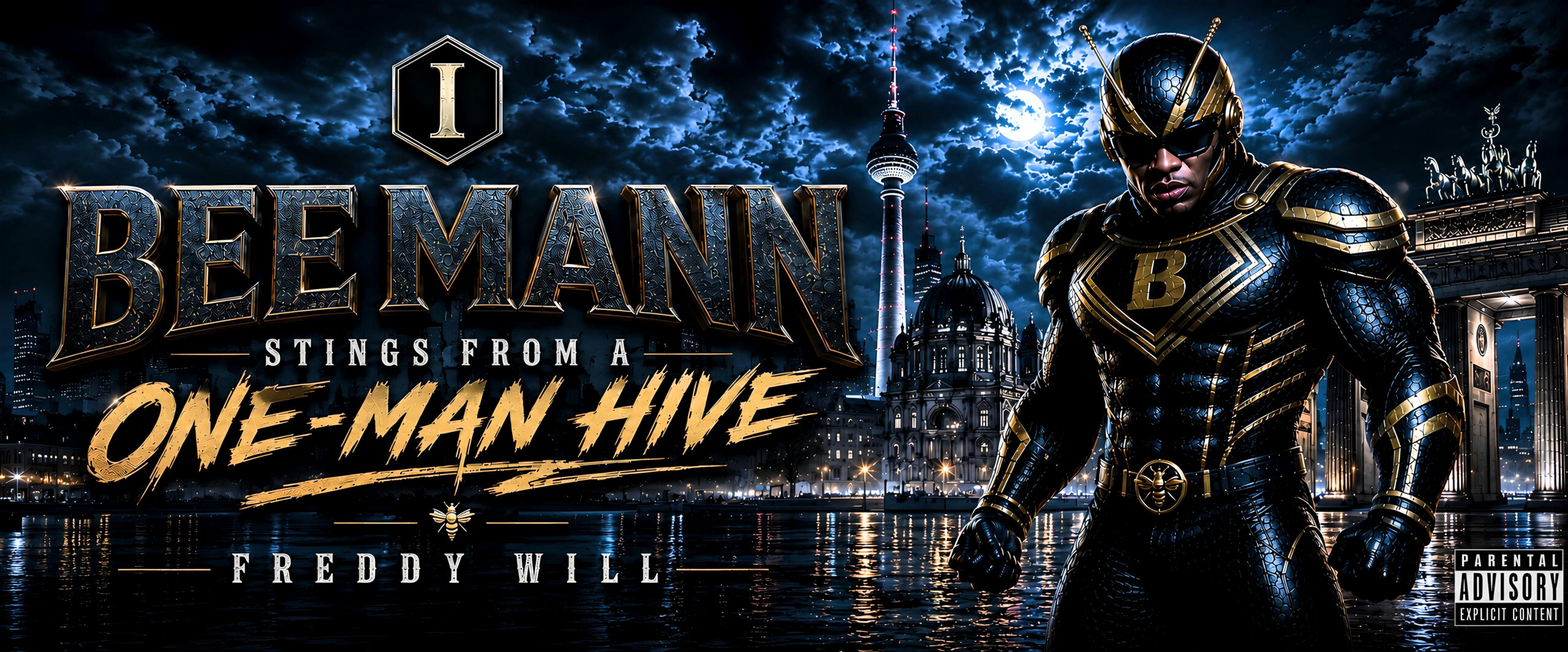
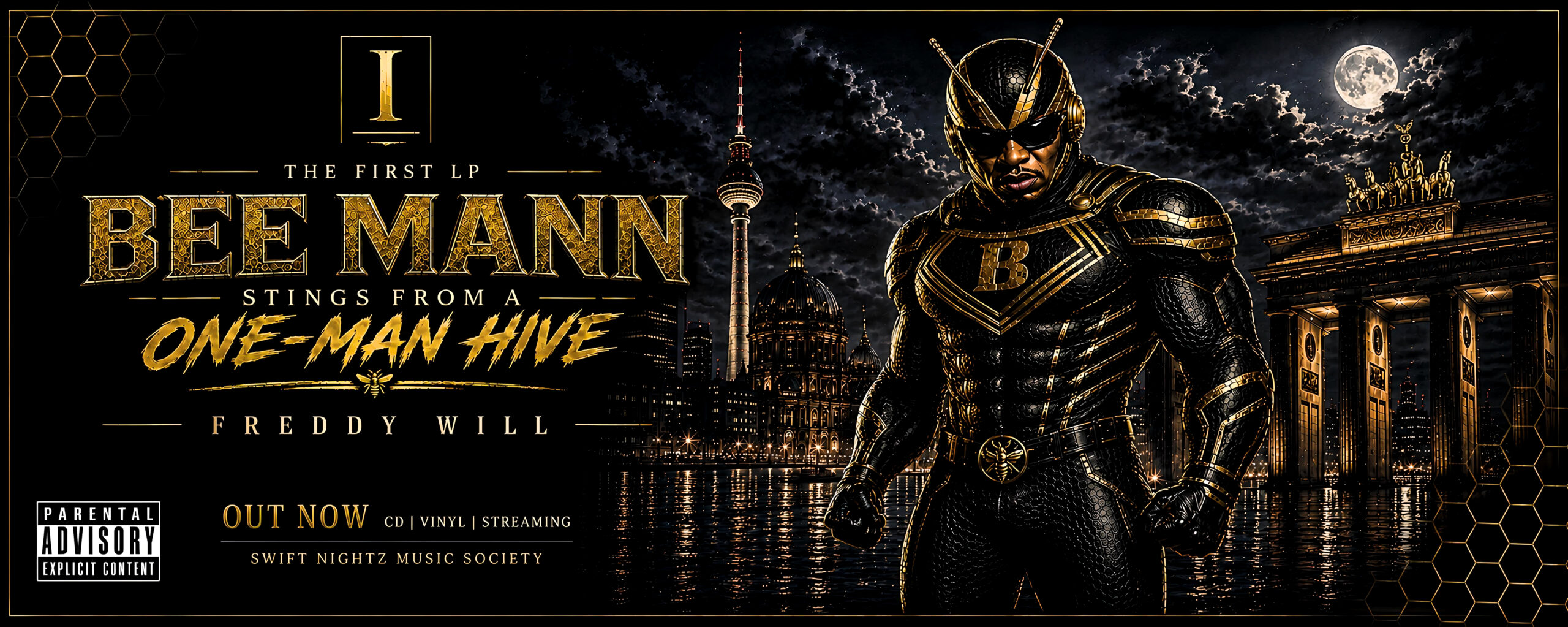
Every mythology has an origin point. This one is a Wannsee estate that doesn’t exist yet. I built a character built from the logic of a beehive with twelve tracks that turned an annotated collection of poetry into sound. Bee Mann: Stings from a One-Man Hive is the first Bee Mann album. Released May 10, 2026, on CD, vinyl, and streaming through Swift Nightz Music Society. It is the companion to Book One of the same title, a 25-track annotated poetry collection that Badson Publishing published. As a result, this first LP carries the first twelve of those tracks: poems transformed into records, characters into melodies, and ideas on the page into a sonic hip hop crossover world.
This is where I first introduced the Bee Mann mythology.
Who Is Bee Mann?
Strip the armor, the honeycomb gold, and the superhero mythology, and Bee Mann begins with a simple idea. Freddy Will and the Hive. A beehive is an extraordinary social organism. Its survival depends on communication, speciality, collective purpose, and individuals functioning as part of something larger than themselves. This became the foundation of Bee Mann. His Hive is the Wannsee estate he shares with his wife, Amira Will, and their three children. Everything he builds, everything he protects, and every sting he takes ultimately comes back to that Hive. However, there is another member of the mythology that people sometimes overlook. Berlin.
In this mythology, Berlin isn’t merely where Bee Mann happens to live. The city functions almost like another character. World War II devastated Berlin. It was divided, reconstructed, reunited, and reinvented. Berlin’s history of collapse and reconstruction resonated with me. I was living through my own version of starting again when I left Canada and eventually rebuilt my life in Germany. Which is why Bee Mann and Bee Woman aren’t superheroes who solely happen to operate in Berlin. They are Berliners. The city belongs to their identity because the mythology shares one of Berlin’s fundamental propositions: something can be broken without remaining broken.
Production Note
Beyond the mythology, Bee Mann is Black speculative literature I designed to move beyond books and music into comics, television, and film. LP1 starts the machinery. How did I produce albums? People sometimes assume that a layered project requires a major record label, a conventional studio team, and the huge budget independent artists dream about. Fair assumption. I build records as a puzzle, assembled piece by piece. I perform the rap verses and write every hook myself. But a record is never just one voice. It is drums, bass, instrumentation, arrangement, background vocals, engineering, mixing, and mastering. I assemble that around a crossover.
In practice, some pieces I create myself in Cubase, Pro Tools, or a DAW. Others come from musicians working remotely around the world. I might need a particular drummer, bassist, instrumentalist, or vocalist. Then find the right person, sometimes through platforms such as Fiverr, and send the reference, tempo, key, and creative direction. They record their part and send the stems back. I then assemble those elements into the larger record I’m hearing in my head. It is less like standing in one studio with a band and more like directing a production whose studio happens to stretch across several continents. AI became another instrument in that environment.
Artificial Intelligence
I leaned on AI for tone correction and harmony generation. Mixing. Mastering. Moreover, I’d say this technology is part of a longer continuum. MIDI evolved music production. Digital recording changed it. Pitch correction evolved it. Software instruments changed it. Remote collaboration evolved it. AI is yet another development in that history. The distinction to me is authorship. AI didn’t compose a single song on this album. I did. Technology helps me swing the pendulum between imagination and execution. It doesn’t determine what I create. That is the production story behind LP1: one artist, collaborators scattered across the world, and every useful tool I could put my hands on employed in the service of one coherent vision. Which, come to think of it, sounds rather like a hive.
The Tracklist
1. The Hum
The album’s opening invocation. Before you see Bee Mann, you feel him, that vibration, that frequency shift in the room. Ultimately, The Hum is his signature energy, tied back to the primordial idea of “let there be light.”
In other words, it is the original frequency from which the mythology grows.
2. City Kid
The mythology’s origin story. It begins when a West African market becomes the original hive: danger, hustle, community, elders posted like sentries, the block, and a boy learning to fly long before he has wings.
3. Frontin’
The cost of getting there. “Used to roll with family, lately it’s only me.” Success and isolation occupy the same space. The glow of achievement sits beside the loneliness sometimes required to build it.
4. Suddenly
By contrast, we have a short atmospheric interlude in Suddenly. It deliberately lowers the temperature and quietly expands the mythology between the harder records surrounding it.
5. Mansplainin’
In short, this is a deliberate reclamation of the title, inspired by the bee’s waggle dance—the remarkably precise communication system honeybees use to convey information about resources. Here, the concept becomes communication between partners. Like the Bee Mann and Bee Woman, a man attempting to speak clearly and directly to the woman beside him, not over her. Even so, this song leans heavily on a Rock and Roll vibe.
6. Hissy Fit
Then, relationship turbulence becomes an issue. She says he’s gone too much. He believes he’s out working to make the hive elevate higher. Neither concern automatically cancels the other. That’s what makes the record interesting: the collision between ambition and presence, provision and intimacy.
7. Clutch
More importantly, this song speaks of reliability when it matters—for family, community, and love. At the same time, the song also draws partly from his diplomatic-life backstory and interplays with “clutch” in two senses: performing under pressure and the mechanical component that keeps moving parts connected.
8. Accuse Me, I’m Dope
Taken together, Mansplainin’, Hissy Fit, and Clutch spawn defiance. Nearly two decades of people trying to knock him down, block him, undermine him, count him out, or tell him what he cannot become—and the irritating habit of continuing anyway. Sometimes survival is philosophical. Sometimes it talks trash.
9. Afropolitan
At this point, we reach the identity anthem. All told, dual citizenship and belonging. Code-switching. Cultural fluency. Movement between numerous communities. This song is also a direct rejection of flattened representations of Africa that reduce an enormous continent and its global diaspora to poverty, catastrophe, and cliché.
10. Beestings
From identity, the album turns inward. Its most reflective moment arrives in this track that gave the larger project its name. Beestings equals sustenance. More fundamentally, this is independence stripped of bravado: learning not to require outside validation before believing in the value of what you were built from.
11. Killer Instinct
Sierra Leone’s child. War drums. Ashes. Survival. Kingship. This is the condition the hive demands from Bee Mann, whether he’s wearing the suit or not: the warrior who survived because he learned how to survive—and who ultimately built something afterward because mere survival was never going to be enough.
12. Berlin, Berlin, Berlin
Finally, we arrive in Berlin: the city where the journey settles and rebuilding begins. Personal biography and superhero mythology finally converge around the same idea. You can survive the collapse. But eventually, you have to build somewhere.
The Making of the Singular Self
Taken together, these twelve records tell the story of the making of a singular self. A boy begins with very little and learns to survive largely through his own instincts. He crosses countries, identities, relationships, and ambitions. Then discovers what independence costs. He learns that strength can protect and isolate you at the same time.
And eventually, he builds a hive. My personal favorites from LP1 are The Hum, Killer Instinct, Berlin Berlin Berlin, and Afropolitan. The listeners have made their own choices: Clutch, Accuse Me I’m Dope, and Afropolitan have emerged as fan favorites. I like that overlap. Apparently, Afropolitan is where the Hive and I have agreed to stop arguing. The book tells the story in verse. The album tells it in sound. And neither one is really the destination. They’re the entrance. Bee Mann: Stings from a One-Man Hive is where the Hive began. And the story continues in LP2.