 0
0
 0
0
I have always been an Abrahamic thinker before I was ever a denominational one. Eastern Orthodox by faith, yes, but a man who has read the Quran cover to cover, who has sat with the Torah the way you sit with an elder, who identifies, in the quiet places of his own spirit, with the Tribe of Issachar, the ones who were never known for their strength or their numbers, but for understanding the times, for knowing what a people ought to do when the moment demanded it. That inheritance shapes everything I build, including this mythology.
So let me tell you where Giant really came from.
I used to ask myself a simple question that never had a simple answer. In the story of David and Goliath, who was actually the giant? Everybody answers too fast. Goliath, they say. The big man. The loudmouth. The armor that caught the sun from three fields away. But I sat with that story longer than most people sit with anything, and I came to a different conclusion. Goliath was never the real giant. He was simply a man who lost, catastrophically, and represented a weaker god who lost with him. And here is the part that will make some of you shift in your seat, the God of Israel was not spared that same humiliation forever, either. The kingdom of Israel fell. It was wiped from the map in its time. Every nation that has ever stood behind a God/god has, at some point, tasted the ground.
David was the giant. Not because of what he looked like walking into that valley, a boy, a shepherd, the one his own father did not think to call inside when the prophet came looking for a king. David was the giant because of what he built after the stone left his hand. He did not stop at Goliath. He took the giant’s army too. He took the throne from the very man who once discovered him and made him a servant in his own house. He took wives from husbands who could not stop him, and I will not pretend that was clean. I know the story of Uriah, I know what David cost that man to have Bathsheba, and I carry that knowledge with me rather than around it, because the same book that calls David a man after God’s own heart does not hide what he did to get there. That is not a contradiction I need to resolve. That is the truth about what greatness actually costs, and what it survives.
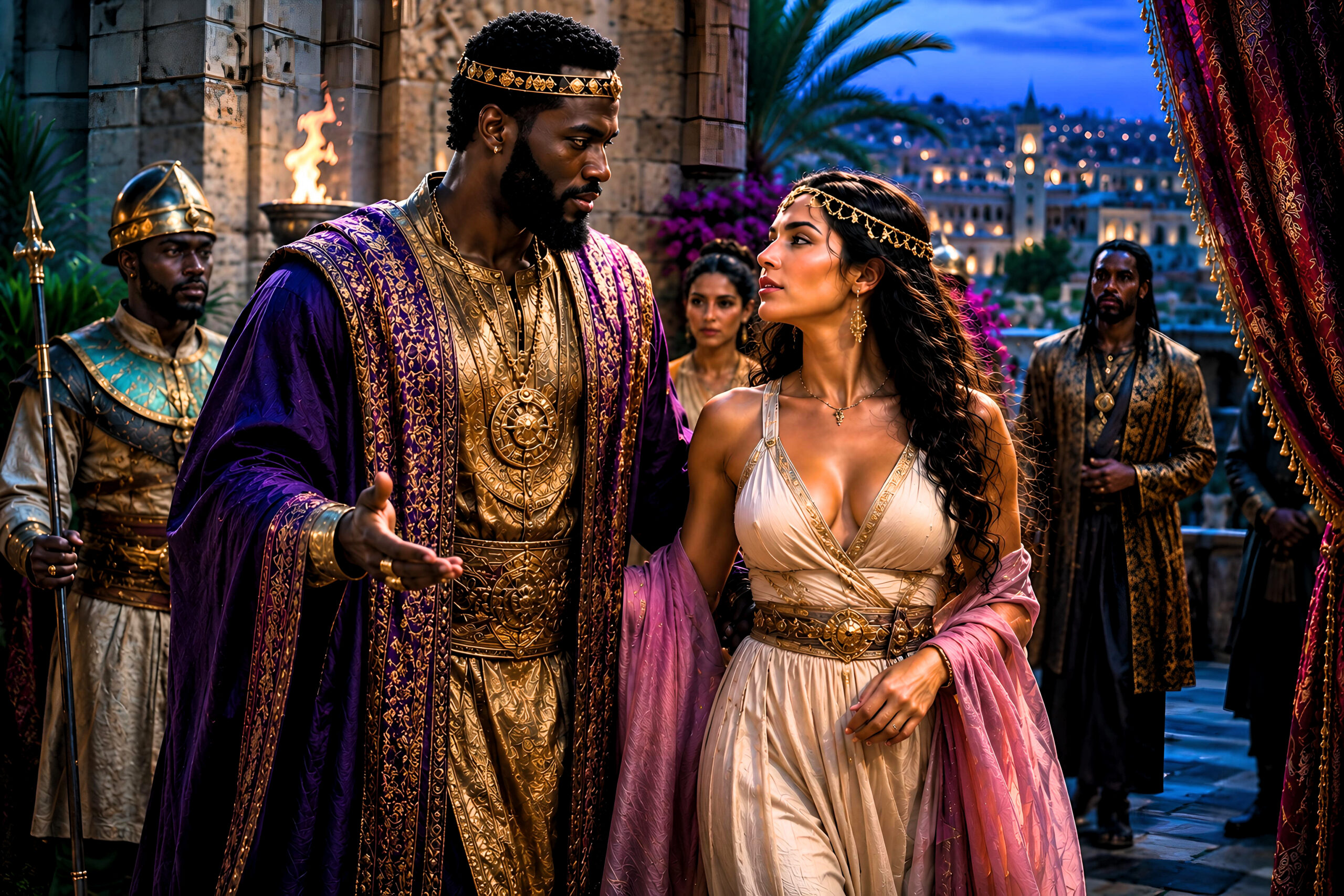
David conquered powerful cities. He built wealth that outlived him by centuries. He died old, which in that world was its own kind of miracle. Also, the dynasty that came out of him did not stay in one place. It traveled. It reached Ethiopia, carried through his son, King Solomon and the Queen of Sheba, a line the Kebra Nagast holds sacred to this day, a line emperors on that continent invoked into the last century. And if you follow the thread all the way through the Gospels, you find Jesus Christ himself traced back to the house of David. One shepherd boy. One stone. A lineage that outran empires. But here is what I keep coming back to, what actually sits with me at night. David never called himself a giant. He never had to. He let the consequence of his life do the naming for him.
That is the whole seed of this mythology. That is why the Bee Mann was never built to announce himself.
The bee is small. Easy to overlook. Easy to underestimate, the way the enemies overlooned David as a shepherd because it was easy to overlook him, standing next to a tall man in bronze armor. But the bee holds up an entire ecosystem on wings you could miss if you were not paying attention. That is the same architecture behind Giant, my song off Bee Mann II. It was never meant as a boast. It was meant as a confession dressed as a victory record, because I know exactly what it cost to become something after starting as nothing, and true size was never about the noise you make walking into the room. It was about what still stands after you have already left it.
Now let me tell you how that same idea moves across the two volumes of this record, because it does not stop at one song, it is the architecture of the whole mythology.
Volume One is the making of the singular self. Every track on that record is building one argument, a boy who started with nothing, abandonment, rejection, danger, and taught himself how to survive alone, and the album never once looks away from what that survival actually cost him. City Kid gives you the origin. Frontin’ names the loneliness that came with rising above where he started. Mansplainin’ and Hissy Fit are the first real tests, whether a man built entirely for self-reliance could actually let someone stand close enough to matter. Accuse Me, I’m Dope and Killer Instinct are the armor, the receipts of every attempt made to knock him down, and the record that none of it worked. Afropolitan and Beestings are where the identity finally becomes something he could name for himself, not something the world assigned him. And Berlin, Berlin, Berlin closes the volume on arrival, a man finally standing still in a place he chose rather than a place that chose him. The title itself tells you the thesis before the first track even plays. One-Man Hive. Singular. Self-built. And still, if you listen closely, still alone at the center of it, even surrounded.
Volume Two is the collapse of that singularity, and I mean that in the best way a collapse can happen. The title track opens with the cost of ascension itself, the truth that power without tenderness is just a weapon with nowhere to rest. Cocaine Witch and Toxic are where the real turn happens, the story stops belonging only to him and becomes the story of what his mission costs someone else, Amira, who had lived at the edges of the narrative up to that point and now becomes its second protagonist, not its supporting character. Road Wins gives that shift its full architecture, the forager and the drone, two different roles inside one hive, neither complete without the other. Giant makes the whole argument plain, humility, not bragging, because the strength it takes to rebuild something together will always outweigh the strength it took to survive something alone. Wasp Mann and Queen’s Sting bring the real threats into view, and Amira defeats one of them entirely on her own, which tells you plainly, she was never a supporting character in this mythology, she has always carried her own. Ill Intuition and Shit Could Wing Left are the matured version of Volume One’s defiance, no longer watch me survive, but here is exactly how thin the margin still is, even now, even after everything we have built. Too Many Enemies counts what actually stands against the hive. And HoneyComb closes the loop, the hive complete.
So here is the throughline, the whole argument, sung twice from two different altitudes. Volume One answers how does a man become the Bee Mann. Volume Two answers the far harder question, what does it cost to keep being him, and who else is paying that cost beside him. The title carries the entire argument once you have lived inside both volumes, One-Man Hive was never fully true. It was simply the story a man could tell himself while he was still building alone. By the end of Volume Two, the hive is no longer one man. It is a Queen who fights her own battles and wins them. It is three children already absorbing the frequency before they have the words for it. And it is a title that Volume One earned honestly, and Volume Two, quietly and permanently, complicates.
Survival is a solo act. But nothing worth surviving for stays that way. That is the whole mythology, and that is the whole truth of the giant, the one from that valley, and the one I have been building, sting by sting, ever since.