
 0
0
 0
0
To appreciate the poem PantyDown, the reader must first understand the earlier poem, Hissy Fit. That sixth poem (in the book, Bee Mann: Stings from a One-Man Hive) documented one of Amira Will’s rawest pains. Not the pain of betrayal or the pain in the poem Toxic. The rawest pain of a woman, a wife, who loves her husband completely and has begun to suspect that the completeness of her love is not being met by the completeness of his presence. The frequent diplomatic missions in Brussels. The interdimensional journeys, contact with advanced, often humanoid civilizations, absorption of their frequencies, and return to Earth heavy with pollen and new knowledge.
The publishing house. The manuscripts. And the twenty books and the mythology. The Rolex tracking dimensions while the estate at Wannsee sat with the windows lit, children asleep, and the Queen waiting.
Beforehand, Hissy Fit is the chapter or poem where Amira names what his absences cost them. Subsequently, PantyDown is where Bee Mann answers her. Not with empty words but with a romantic evening. Quality time. With clearing everything, every mission, every manuscript, every transaction. And being completely present for the woman who has been holding the hive together every time he flew. So, a portrait image opens the chapter’s resolution before the poem begins. The square image above the poem holds the deep wound that preceded it. And the griot reads both simultaneously because the depth of this chapter and its poem and its song requires the damage to be visible before the healing can be understood as healing rather than simply as pleasure.

Look first at the image.
The word TOXIC burns in red neon on the mirror behind them. Its heart underlined, catching the candlelight from the pillar candles in the mirror’s reflection. An untouched cognac glass sits on the marble. This picture stands to the right, its glass cracked in a spiderweb from the center outward. A parchment note lies on the counter with her lipstick kiss pressed below the words: I let you in. And you broke everything I loved. The griot reads every object before reading the people, because the objects are the first argument. The damage is in the room, while the evidence of what Toxic almost ended is on the table. And above it, above the note, cognac and shattered frame.
Amira is kissing Freddy. He is in a black tank top, a chain at his collar, the Rolex at his wrist, the arm that once held the M16 in the alley now wrapped around the woman he crossed every dimension to return to.
She is in a black silk and satin nightdress, her hand pressed against his chest, her eyes closed, her face lifted toward his. The chandelier above them. White candles are lit. The kiss is happening above the evidence of everything that almost ended them. They chose to have the kiss above the damage. Not despite the note. Because of it. They came back. They always come back. And the desire survived everything the note describes. Now look at her. The rooftop terrace above a European city at golden hour, the sky gone rose and violet and deep amber behind the dome and towers of the city below. Amira Will stands beside the marble bistro table in a black cutout minidress, lace strings hugging her bare skin on each side, the B pendant catching the last light at her throat.
White roses in a glass vase on the table. Two candles are burning. A glass of red wine poured and waiting. The city of Berlin blazes in every direction behind the wrought iron railing, the whole of the skyline laid out below her like the world arranged itself at her feet for this romantic evening. She is not performing for the audience. She is standing in the chapter’s most complete image of what the Bee Mann came home to. The dress barely contains her body. The B pendant marks whose frequency she carries. And the wine is already poured because she was ready before he arrived. She is always ready before he arrives. That is her German inheritance: the innate warmth prepared in advance, the table set before the knock at the door, the cariño expressed before it is asked for.

The evening began in the back of an Aurus Senat from Black Lane. Russia’s premier luxury sedan blending an imposing presence with modern elegance. That massive full-size sedan with that long, commanding profile. It was the Senat Long version. This ride features a bold vertical chrome grille, LED headlights, a sculpted hood, and clean, monumental lines that give it a timeless, authoritative presence. In black, it looks mysterious, powerful, and ultra-exclusive. The Turkish chauffeur moved through the glittering streets of Berlin in silence, which is what good chauffeurs do, and Amira was beside me in that dress, the scent of her like warm coffee and vanilla, bold and skin-close and utterly edible, and I understood immediately that she had not dressed for the restaurant.
She had dressed for me. That distinction matters.
A woman who dresses for a room is different. A woman who dresses for her husband? What she communicated in the back of that car was the same thing she communicated the first time I walked into her life. I am here. I chose you and I am not waiting for you to notice. Because I know you will. That communication hit me at 1,000% before we said a word about where we were going or what the night held. The Bee Mann… with his six activated powers and his multiversal range and his swarm orbiting him across dimensions, elevated to the eager husband in the back seat who cannot take his hands off his wife. Hence, in between his reach, she leaned in to savor his every touch.
The rooftop chic terrace received them the way the best evenings receive the people who deserve them. As though it had been arranged by a frequency rather than their reservation. Accordingly, the griot must document the meal because the meal is PantyDown’s most romantic detail. It is proof that this evening was not an event but a restoration. The Puten-Schenkel arrived perfectly grilled and baked, the skin golden and charred from a two-zone fire, the herb-garlic dark meat pulling from the bone with the tenderness of something that had been given exactly the time it needed to become what it was going to be. Charred zucchini, succulent bell peppers, eggplant, asparagus, mushrooms, all glistening with olive oil and fresh herbs in the candlelight. A garlic-herb cauliflower mash, rich and creamy, the comforting carb substitute Bee Mann has lived by since his diagnosis.
And the Bordeaux, the sommelier’s deepest recommendation, earthy and velvety and profound, the kind of wine that does not hurry the evening but deepens it. The doting couple fed each other bites and laughed, letting the city lights blur below them as the tension that had been building since Hissy Fit and through Toxic finally reached its destination. Not a breaking point. A melting one. The blue rose lying at the edge of the table is not a decorative choice. In the griot tradition, the gewel and the jeli, West Africa’s oral historians and praise-singers, have reached for the impossible image when the ordinary image is too small to hold the truth they are carrying.
A blue rose does not grow in any field the natural world produces. It must be made, coaxed into existence through extraordinary intention, through the refusal to accept what nature declares cannot be possible. It is the flower of hidden knowledge, of admiration too deep for the common vocabulary, of a beauty that lives in the space between what is real and what is dreamed into being by someone stubborn enough to dream it. Amira carried the blue rose through the garden corridor in Cocaine Witch. And now it reappears on the Berlin rooftop in its PantyDown predecessor. It is here again because he placed it deliberately. What the hive builds does not stay in one poem.
The impossible marriage.
The impossible flower.
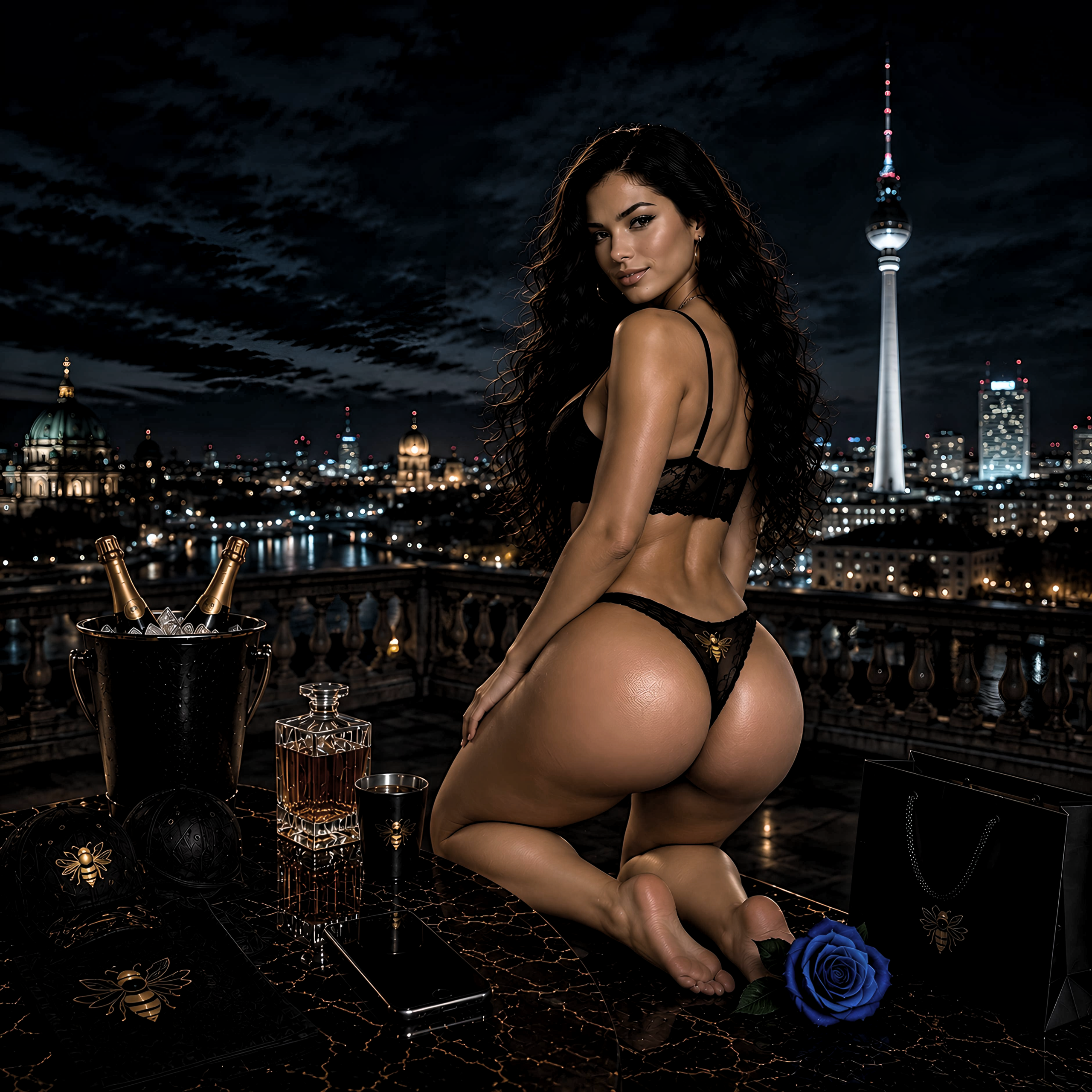
The same refusal to accept what nature and circumstance and the sad parchment note on the counter declared could not survive. Both are still here. Both flowers are still blooming. After dinner, the chauffeur brought us to the Waldorf Astoria, and what followed was sensual and romantic. It was a homecoming. Months of missions, dimensions crossed, civilizations contacted, their technologies and cultural architectures absorbed and carried back to Earth the way the forager bee carries pollen back to the comb, heavy with what the field produced, ready to process it into something the hive can use. All of that had been conducted at the cost of evenings like this one.
Previously, Hissy Fit. Amira named it. I heard it. And tonight was my answer. Not in words. The Bee Mann with the armor and the scepter and the solar fire is also the man who cleared his entire calendar, called the Black Lane, chose the restaurant with the rooftop and selected the wine, and made sure the blue rose was on the table before she arrived. The suit amplifies what is already there. And what was already there tonight, what is always already there when she walks into a room in that dress with that scent and that smile, is a husband who is completely present. Mi amor. That is the poem. The poem that follows is Bee Mann’s most intimate document in this book.
Furthermore, not the armor. Or the scepter. Not the dimensional flight or the swarm command or the sonic frequency that can redirect small celestial bodies. The man in the black tank top, his Rolex at his wrist, both arms around the woman he chose and keeps choosing across every distance his life has required. Mein Schatz. The German she taught him. My treasure. That affectionate German term of endearment. My darling. My sweetheart. Honey. Babe. Ich liebe dich, mein Schatz. In the context of PantyDown, mein Schatz is what Bee Mann calls Amira during their romantic night. Because in the mythology mein Schatz is what he always calls her.
“Komm her, mein Schatz,” he whispers…
The language of her bloodline, the tongue in which Schnuckelchen means cuddle-bug, and the act of claiming someone as yours. He learned it for her, he says it to her and he has been saying it since the first time she walked into his life. The poem does not need translation. Mi amor says everything the armor cannot. The hive does not produce honey for itself alone. The honey has had a destination, and that destination is not the mythology or the catalog or the twenty books or the publishing house in Berlin. It is Amira on a rooftop terrace at golden hour with the B pendant at her throat and white roses on the marble table and the city blazing below and a glass of Bordeaux poured before he arrived because she was ready before he was there because she has always been ready.
Frequently, the Bee Mann flew over Atlanta and landed in Times Square and crossed seven dimensions and stood in the Grand Place in Brussels with both hands open and came home to her every single time. Consequently, this is what he came home to. The kiss above the parchment note. The rooftop above Berlin, where the chapter moves from damage to desire to declaration, with the complete architecture of a marriage that has survived what this one has survived and is still choosing each other above the evidence of everything that could have ended it.
She is Roman Catholic and monogamous and fiercely territorial, and she has chosen this man across every distance his life has required. Certainly, the lace panty is going down tonight, not because a stranger walked in. Because the wife is on the rooftop and her husband is completely present. Because the Bordeaux is open and the city is below and the blue rose is on the table and the B pendant is at her throat and the Hissy Fit has been answered. That is the resolution. The wife has always made the only entrance that really mattered. And tonight she made it in that dress. The Bee Mann, who traverses stars and guards the Wannsee gate and carries six activated powers across the multiverse, did not look at a single dimension other than the one she was standing in.
That is the honey.
That is always the honey.
And it was worth every sting it cost.