 0
0
 0
0
The most dangerous thing you can do to a creative person is make the world believe they don’t exist.”

The Decision
Twenty-one years ago, I made the kind of decision that changes the entire shape of a life. I quit my job. I put my house up for rent. I handed my car to a relative. And I bought a ticket to Toronto to record my debut album.
Before that moment, I had been doing everything a young Black man in America is told to do. I worked hard. I built toward something. I loved a decent-looking woman and tried to build a future with her, provider, protector, penetrator in the most traditional sense. But she was honest with me in a way I had to respect: she didn’t need more money or more things. She needed more of me. I was always working or sleeping, and she wanted out.
When that relationship ended, something clarified inside me. I had put my music career on hold to meet the expectations of people around me. I had poured everything into a life built around other people’s definitions of success. And it still wasn’t enough. So I asked myself a question that I have never stopped asking since: why am I doing anything other than the work I was born to do? That was to be a writer and a musician.
In 2005, choosing Toronto over Los Angeles looked like a strange move to most people. It wasn’t a relocation. It was a recording mission. The plan was to complete the album, then bring it to the major labels. What followed was one of the most formative periods of my life, and also the beginning of something I did not yet have a name for.
Building Something Real
My early days of trying to record my debut album in Toronto were turbulent. Producers made promises they didn’t keep. Collaborators disappeared. There was fallout, betrayal, and more than a few moments where the whole project nearly collapsed. Some people saw me as an easy person to scam. But then I met Choice MC and his partner, Raymond, and the energy shifted completely. I met the Augustine family and the Bullens. From that point forward, I wasn’t struggling to complete a mixtape anymore. I was recording full-length studio albums.
Over the next two to three years, I moved back and forth between Canada and the United States (New York, Toronto, Jersey City, and Philadelphia). I applied for temporary residency, then permanent. I became, in every way that mattered, Canadian at heart. And then Ken Cowle entered the picture, and fulfilled my dream to become an author. The music and the literature were happening simultaneously. The independent infrastructure was taking shape.
That is what they saw. And that is what they decided to take.

The Proposition I Refused
I will not name them. Not here, not yet. I will call them what they revealed themselves to be over twenty years of behavior: predators who prey on independent artists. If, in fact, they are the ones behind these attacks.
They came to me with a proposition. In exchange for a 500 Canadian dollar signing advance, I would sign over all rights to my music. They would receive writing credits on every song I had created. In return, they claimed, they would make me a “superstar.” They said they had connections to important gatekeepers in the industry.
Five hundred dollars. For everything I had built. For my name, my voice, my catalog, my future.
I said no. For me, the conversation ended there. I had not sacrificed a career, a relationship, a home, and years of my life to hand the fruits of that sacrifice to strangers for five hundred Canadian dollars. No amount of industry access was worth my creative sovereignty. That was, and remains, non-negotiable.
But for them, the conversation was just beginning.
The Campaign: A Documented Timeline of Crimes
What followed my refusal was not a grudge. It was a campaign. Methodical, sustained, international, and criminal. I am documenting it here in full, on the public record, because the world deserves to know what independent artists face, and because the relevant authorities in multiple countries deserve a clear account.
It began with the physical. Someone called border authorities and attempted to have me flagged and prevented from re-entering Canada. I do not use drugs. I have never trafficked anything. The accusation was designed to create a file, to generate a paper trail of suspicion around my name. It failed, but it was only the first move.
I’m sure that the people who made the proposals are behind this, but someone moved on my professional infrastructure. Promotional posters and flyers disappeared. Show venues received calls with false statements about me, and bookings were cancelled. Supporters were contacted with fabricated allegations. My intent to build an audience, city by city, was being systematically dismantled from a distance. Plausible deniability.
Then came the digital escalation. Using my public Facebook posts, they identified my IP address. From that IP address, they triangulated my physical location. They then used that location data to contact local law enforcement and other authorities with false statements. This is not speculation. This is a pattern I lived through across multiple countries over nearly two decades. I want to be precise about the legal reality: using someone’s social media activity to identify their IP address, using that IP to locate them, and then using that location to file false reports with law enforcement constitutes stalking, criminal harassment, and in the international context, a series of federal cybercrimes across multiple jurisdictions. The kicker is, they have been doing it rather boldly.
I began to notice I was being followed. I would get into my vehicle to drive to a recording studio and find a car tracking my route. This continued for years. They knew I was not someone who could be approached directly. So they maintained their distance and continued their campaign through institutions and platforms instead.

Going International: The Crimes Follow Me to Europe
When the opportunity to move to Europe came, I embraced it. I had believed, perhaps naively, that crossing the Atlantic Ocean would put distance between these individuals and me. Instead, their operations expanded.
In Europe, the same playbook continued with international reach. Authorities in the countries where I was living, visiting, or touring received calls with false statements to attract negative attention. Radio stations were contacted. The objective was the same: to make me radioactive, to make institutions and collaborators afraid to associate with me, and to create the impression that I was either a criminal, a fraud, or simply irrelevant.
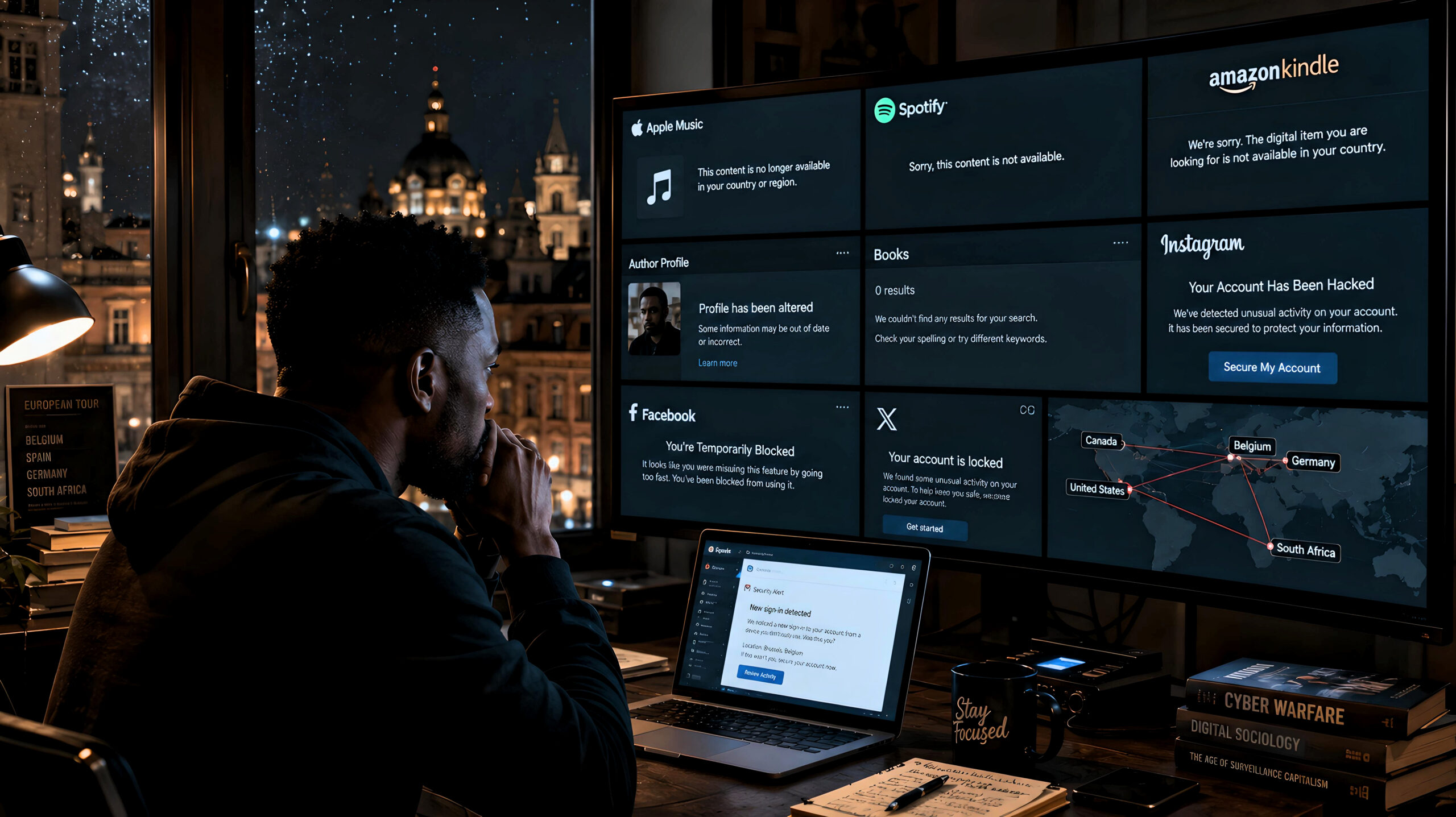
The platform attacks intensified. I am documenting some of the specific targets here for the record: Barnes & Noble (I had ten books in this story. They remove one every few months). Wikipedia (posing as administrators or editor they have basically established that they can vandalize any profile with impunity). Basically, they appear to be a team. They create several fake or alternate accounts, make a false statement, ignore all evidence, use their fabricated statement as an excuse to hack in and forcefully vandalize the profile. GoDaddy (they tried to take down or corrupt my website when I was still on that platform). Facebook (they hack in, remove views, remove followers, harass people who share my posts, and delist my profile so my friends and followers don’t see my posts).
Instagram (remove followers). YouTube (remove views and comments). Tinder (they created fake profiles and contacted me as if they are legitimate matches and used the opportunity to ask personal questions. They also hacked into the system and manipulated my profile so it’s invisible to other users). Plenty of Fish. Google (hack my emails, delist my key links from search results). Multiple search engines. etc. They visit my platforms regularly. The method is consistent: gain unauthorized access to administrative tools on any platforms, locate anything connected to my name, and vandalize or remove it. My books, distributed through a legitimate third-party network, were removed from storefronts. My interviews were delisted from search results. My music links taken down.
My author profiles were altered.
I want to be clear about what this means legally. My books are distributed through a respected international literary distributor based in Oxford, the United Kingdom. When these individuals hack into a retail platform and remove my titles, they are not only committing a crime against me. They are vandalizing a third-party institution that has no involvement in whatever grievance these people carry. Every bookstore, every platform, every search engine they compromised is a separate victim and a separate count. They have committed these acts while I was in Canada, the United States, South Africa, Belgium, the UK, Spain, and Germany. That is not a grudge. That is an international criminal enterprise targeting a single artist across seven countries over nearly twenty years.
They placed a notice on my Wikipedia page referencing paid editors, a signal that they are aware I have financial resources and are attempting to preemptively discredit any effort I make to maintain accurate public information about my work. That detail matters. It tells you this is not random. It is targeted, informed, and ongoing.
What They Are Trying to Prove, and Why They Will Fail
I have had twenty years to study their strategy. The goal, as best I can interpret it, is to manufacture the appearance of irrelevance. If they can remove my books from enough stores, delist my name from enough search engines, cancel enough shows, and frighten enough collaborators, they can construct a narrative that no one cares about my work. In their mind, no one should be interested in or engage with my work, and if anyone did, they have the right to hack into any platform whatsoever and physically disconnect that connection stubbornly.
The irony is as dark as it is revealing. They themselves have spent twenty years caring intensely about my work. They have dedicated more time, energy, and apparent resources to monitoring and undermining my career than most artists ever receive in attention. If my work were truly irrelevant, there would be nothing to attack. The people behind these attacks are not trying to prove I am unimportant even when I happen to be. They are trying to prevent me from becoming important enough that someone holds them accountable for what they have done.
The Stakes Are Not Abstract
I am a husband and a father. My wife and children are sometimes with me when I travel for vacation, performances, and literary events. The presence of individuals who have demonstrated a willingness to contact law enforcement with false statements, follow my route, and maintain an illegal surveillance operation across international borders is not a professional inconvenience. It is a threat to my life, my family’s safety and my income stream.
When my children travel with me to a book event in another city and I am being illegally surveilled (smartphone and computer being hacked) or have reason to believe false statements have been made to local authorities about me, that is a different kind of danger. It is the kind that has no clean resolution and no easy legal remedy.
I am putting this on the public record because documentation is protection. Every law enforcement agency, every platform administrator, every executive, every woman, and every collaborator who has ever received a call or a message (from someone who did not identify themselves) about me deserves to know that those communications were likely part of a coordinated, criminal disinformation campaign. You are being targeted maliciously.
If you received information about me from an anonymous or unverifiable source, you were likely a tool in someone else’s criminal operation. You were lied to. Come forward with information we can share to go after and stop them.
A Word to Independent Creators
I am telling this story for two reasons. First, to create a documented public record of what has been done to me (my brand, my family, and my fans) and when. Second, to speak to every independent entrepreneur, every artist, every author, every emcee, every producer who has ever had their work sabotaged, their reputation attacked, or their livelihood undermined by people who believed the price of refusal should be permanent destruction.
We live in an era where the tools of harassment are widely accessible and the accountability structures have not kept pace. A determined bad actor (or a group of cyber criminals) with modest technical knowledge can file false reports across jurisdictions, manipulate platform search results, intercept promotional materials, and conduct years-long illegal surveillance campaigns against any individual creator (especially the independent artists or creators), all while remaining effectively invisible to the systems that are supposed to protect us.
When public voices speak about hip-hop fatigue, call entire genres misogynistic, or declare that they will not support certain artists, they are expressing personal positions. That is their right. But when they then turn around and expect those same artists to absorb career and financial risk on behalf of a boycott or a cause, they must understand what that ask looks like from where we stand. There is a broader war against hip hop itself.
I am not just an artist making music and books. I am an independent institution that has been under sustained attack for twenty years. Every business decision I make has to account for threats that most people in this conversation cannot imagine. The calculus of solidarity looks entirely different when your name has been weaponized by criminals across seven countries and two decades. They will be caught and brought to justice.
This Is the Record
I am not writing this from a place of fear And I am very angry. I am writing it from a place of clarity. Twenty years is a long time to be silent about something this serious, and the silence ends here.
To the platforms that were compromised: your security teams have a case to look into.
To the law enforcement agencies in Canada, the United States, South Africa, Belgium, Spain, the United Kingdom, and Germany that may have received false information about me: you were deceived, and the individuals who deceived you committed crimes against your institutions as well as against me.
To my publishers, distributors, collaborators, and readers: the work has always been real. The catalog is legitimate. The career is documented. Whatever you were told from an anonymous or unverifiable source was a lie, and that lie had a criminal author.
To the individuals responsible: I know what you did. I know when you started. I know where you followed me. I know what you removed, who you called, and what you said. This document is not a threat. It is an accounting. And it is the beginning of a much larger conversation.
The griot remembers everything.
Freddy Will (Wilfred Kanu Jr.)
Author | Grammy-nominated Emcee & Producer | Founder, The Theatre of Literary & Performing Arts
Berlin, Germany | publikdiscourze.com | freddywill.de